
Solo creators are outranking corporate sites. Here’s the exact strategy behind it.
Something strange happened on Google this year. A solo blogger writing about sourdough starters started outranking a major food network site. A freelance tech reviewer pushed past CNET on a long-tail product keyword. A small business owner’s blog about local gardening crushed a national home improvement brand.
No massive budget. No 50-person content team. Just one person, real expertise, and a keyboard.
Welcome to 2026, where niche blogging actually fights back and wins.
Google Changed the Rules. Most Big Brands Didn’t Notice.
Google has spent the last few years making one thing painfully clear: it rewards helpful, people-first content. The Helpful Content System, which Google started rolling out in 2022 and has refined through multiple core updates since, specifically targets content that exists only to rank rather than to help real humans.
The March 2024 core update alone reduced low-quality, unoriginal content in search results by an estimated 45%, according to Google’s own blog post.
Big brands took a hit. Many had been publishing hundreds of AI-generated or heavily templated articles per week. Google noticed. Readers noticed too.
Meanwhile, independent bloggers who wrote from genuine experience started climbing the rankings. Not because Google loves underdogs. Because Google loves useful content. There’s a difference.

What E-E-A-T Actually Means for Small Creators
You’ve probably heard the term E-E-A-T thrown around like confetti at an SEO conference. It stands for Experience, Expertise, Authoritativeness, and Trustworthiness. Google uses it as a framework within its Search Quality Rater Guidelines to evaluate content quality.
Here’s the part most people miss: that first “E”: Experience, changed everything for independent creators.
Google now asks: has the person writing this content actually done the thing they’re writing about?
A corporate writer producing their fifth article about camping gear this week probably hasn’t slept in a tent since 2019. But a niche blogger who reviews gear on actual trails? That person demonstrates real experience. Google can tell the difference. So can readers.
According to Google’s Search Quality Rater Guidelines (2024 update), first-hand experience adds significant value to content, especially for “Your Money or Your Life” topics and product reviews.
This is where human content SEO becomes a genuine competitive advantage, not just a buzzword.
The AI Content Backlash Is Real
Let’s talk about the elephant in the room. AI content flooded the internet over the past two years. Some of it was fine. A lot of it was bland, repetitive, and about as trustworthy as a weather forecast two weeks out.
Readers grew tired of it fast.
A 2024 survey by Originality.ai found that 50.7% of respondents said they trust human-written content more than AI-generated content. Only 5.4% said they trust AI content more. The rest didn’t care either way.
Big brands leaned hard into AI-generated content at scale. Many published thousands of articles with minimal human oversight. Google’s systems caught up. Several high-authority sites saw significant traffic drops after the September 2023 and March 2024 updates.
Niche bloggers who kept writing original, experience-based content? Many of them saw traffic increases during the same period.
The lesson here isn’t that AI is bad. The lesson is that lazy content at scale doesn’t beat thoughtful content from someone who actually knows their subject.
Why Niche Blogging in 2026 Favors the Little Guy
Big brands have resources. They have domain authority built over decades. They have entire departments dedicated to SEO.
So how does a solo creator compete?
By not competing on their terms.
Topical Authority Beats Domain Authority
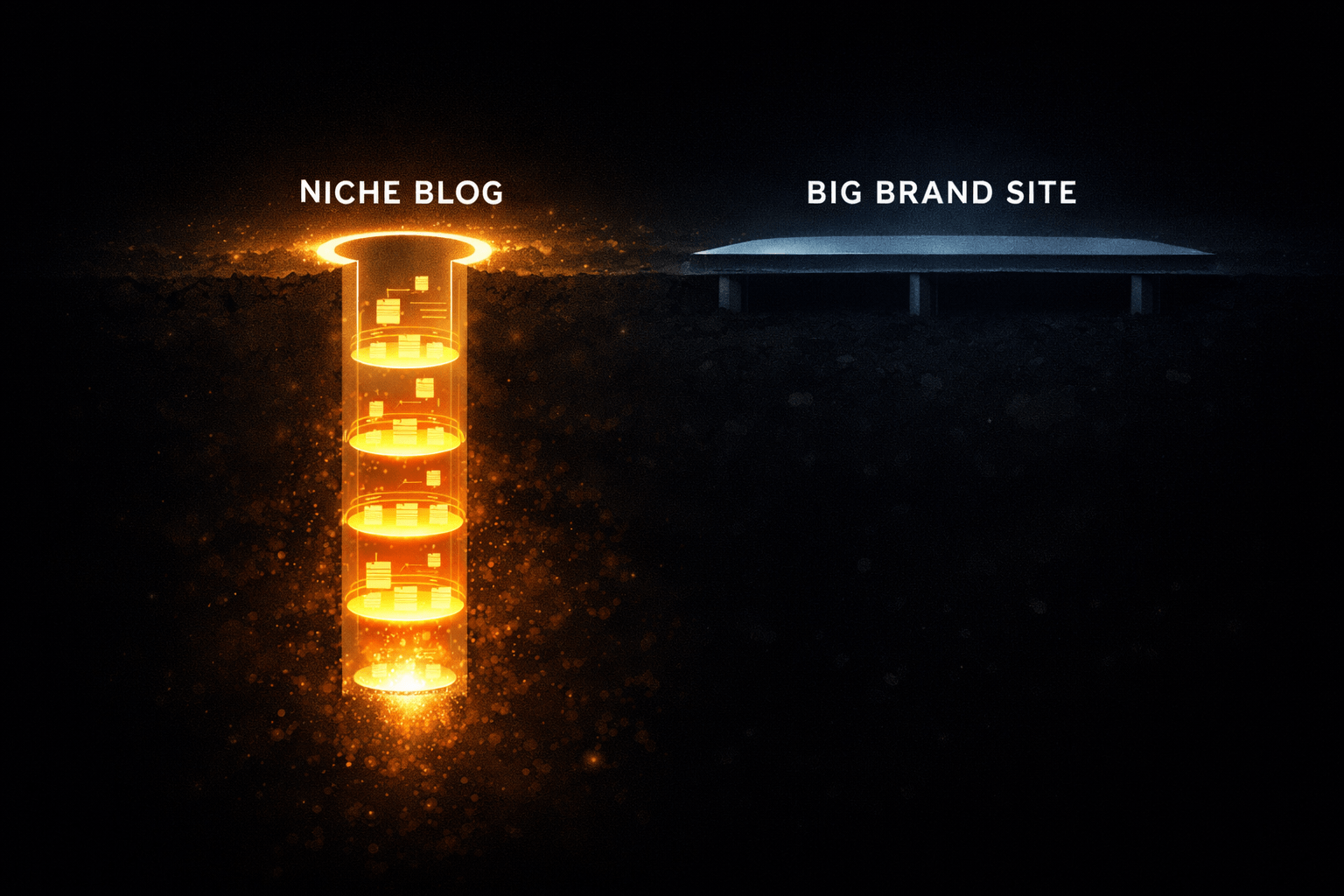
Google increasingly values topical authority how deeply and thoroughly a site covers a specific subject. A blog that publishes 80 highly detailed articles about indoor plant care builds stronger topical signals than a massive lifestyle site that covers plants, fashion, travel, and cryptocurrency all under one roof.
Lily Ray, VP of SEO Strategy at Amsive Digital, has documented multiple cases where niche sites with lower domain authority outranked major publications by demonstrating superior topical depth. She shared these findings extensively at SMX and on her public analyses throughout 2024.
If you want to beat big brands SEO-wise, you don’t need a bigger boat. You need a more specialized one.
Real Voice Beats Corporate Tone
Readers connect with personality. They share articles that make them feel something whether that’s informed, entertained, or understood.
Big brand content often goes through five rounds of approval before publication. By the time it reaches the reader, every edge has been sanded off. It reads like it was written by a committee. Because it was.
Niche bloggers write like humans talking to other humans. That authenticity creates engagement signals longer time on page, more shares, more return visits, that Google pays attention to.
Speed and Adaptability
When a trending topic emerges, a solo blogger can publish a well-researched article within hours. A big brand might take two weeks to get approval, assign a writer, go through legal review, and finally hit publish.
By then, the niche blogger already owns page one.
The Exact Strategy Behind This Shift
Enough theory. Here’s what’s actually working for niche bloggers who rank well in 2026.
1. Pick a tight niche and go absurdly deep. Don’t start a “health blog.” Start a blog about managing Type 2 diabetes through diet. Cover every subtopic thoroughly. Build internal links between related articles. Become the most comprehensive resource on your specific subject.
2. Lead with personal experience. Write about what you’ve done, tested, tried, and failed at. Include original photos. Share specific results. Google’s systems increasingly recognize and reward this type of first-hand content.
3. Publish consistently, not frantically. Two excellent articles per week beat ten mediocre ones. Every single time. Quality compounds. Filler content dilutes your site’s overall quality signals.
4. Build real relationships, not just backlinks. Guest post on relevant sites. Get interviewed on podcasts. Collaborate with other creators in your niche. These activities generate natural, high-quality backlinks that no link-building agency can replicate.
5. Optimize for humans first, then search engines. Write clear headlines. Use short paragraphs. Answer the question your reader actually has. Add structured data where appropriate. But never sacrifice readability for keyword density.
6. Show your face and credentials. Create a detailed author page. Link to your social profiles. Display any relevant qualifications or experience. Google’s systems use author reputation as a trust signal, as outlined in their quality rater guidelines.
What This Means If You’re Just Starting Out
If you’re an independent blogger, freelancer, or small business owner wondering whether niche blogging in 2026 still makes sense yes. More than ever.
The window hasn’t closed. It’s actually opened wider.
Google’s direction over the past three years points consistently toward rewarding genuine expertise, real experience, and content that serves people rather than algorithms. Every major update has reinforced this trend.
You don’t need a Fortune 500 budget. You need a subject you know deeply, the willingness to share what you know honestly, and enough patience to let compound growth work.
The bloggers winning right now started 12 to 18 months ago. The bloggers who will win next year? They start today.
Final Thought
Big brands aren’t going away. They still dominate plenty of competitive keywords. But the gap between corporate content and independent creator content has narrowed dramatically, and in many niches, it has flipped entirely.
Google didn’t hand this advantage to small creators out of charity. Small creators earned it by doing the one thing many big brands stopped doing.
Writing content that actually helps people.
That’s not a hack. That’s not a trick. That’s just good content strategy. And honestly? It’s way more fun than writing like a corporation.
