Search keeps evolving. Google updates its systems regularly, AI changes how people discover content, and competition grows every day. If you want to win in 2026, you need the right SEO tools – not just flashy dashboards, but platforms that provide reliable data and actionable insights.
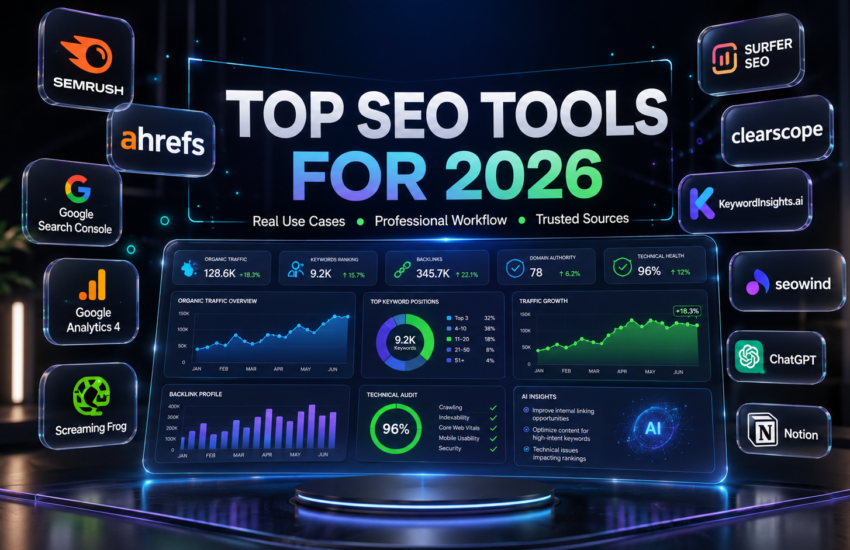
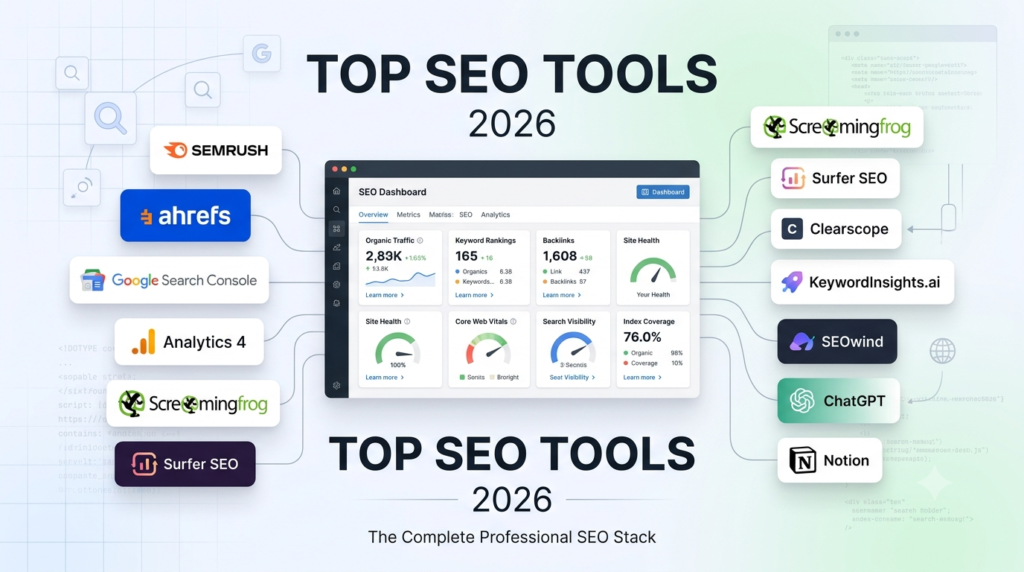
In this guide, I’ll break down 10 SEO tools for 2026 that professionals actually use. These tools appear in the image and reflect real industry standards. I’ll explain what each tool does, who should use it, and why it matters – backed by official sources wherever needed.
Let’s dive in.
1. Semrush – Complete SEO & Competitive Intelligence
Best for: Keyword research, backlink tracking, and competitor analysis
Official site: https://www.semrush.com/
Semrush remains one of the most widely used SEO platforms in the world. It offers keyword research, site audits, rank tracking, backlink analysis, and competitor insights – all in one place.
According to Semrush’s official documentation, the platform provides access to billions of keywords and domain analytics across global markets. SEO professionals use it to:
- Identify keyword gaps
- Analyze competitor backlink profiles
- Track SERP positions
- Audit technical issues
If you want a broad view of your SEO performance in one dashboard, Semrush delivers.
2. Ahrefs – Backlink & Organic Research Powerhouse
Best for: Deep backlink analysis and content research
Official site: https://ahrefs.com/
Ahrefs built its reputation on backlink analysis. It crawls the web constantly and maintains one of the largest link databases in the industry (as stated on Ahrefs’ official website).
Marketers rely on Ahrefs to:
- Audit link profiles
- Discover link-building opportunities
- Analyze top-performing content
- Track keyword rankings
If backlinks drive your strategy, Ahrefs gives you clarity. And clarity beats guesswork every time.
3. Google Search Console – Direct Data from Google
Best for: Tracking impressions, clicks, indexing, and errors
Official source: https://search.google.com/search-console/about
If you use only one SEO tool, use Google Search Console (GSC). It provides first-party data directly from Google.
According to Google’s documentation, Search Console helps you:
- Monitor search traffic
- Fix indexing problems
- Submit sitemaps
- Identify Core Web Vitals issues
No third-party estimates. No assumptions. Just direct data from the search engine itself.
Ignoring Search Console in 2026 would be like driving with your eyes closed.
4. Google Analytics 4 – Measure What Actually Converts
Best for: Tracking user behavior and conversions
Official source: https://analytics.google.com/
SEO does not end with traffic. It ends with results.
Google Analytics 4 (GA4) helps you measure:
- User engagement
- Conversion events
- Revenue from organic traffic
- User journeys across devices
Google officially transitioned from Universal Analytics to GA4 in 2023. GA4 uses an event-based data model, which allows more flexible tracking.
If you care about ROI, and you should, GA4 belongs in your SEO stack.
5. Screaming Frog – Technical SEO Specialist
Best for: Technical audits and site crawling
Official site: https://www.screamingfrog.co.uk/seo-spider/
Screaming Frog SEO Spider crawls websites the way search engines do. It identifies:
- Broken links
- Redirect chains
- Duplicate content
- Missing meta tags
- Canonical errors
Technical SEO forms the foundation of rankings. You can create brilliant content, but if Google cannot crawl or index it properly, performance suffers.
Screaming Frog gives you full control over your technical health.
6. Surfer SEO – On‑Page Optimization & Content Scoring
Best for: Content optimization
Official site: https://surferseo.com/
Surfer SEO analyzes top-ranking pages and provides data-driven recommendations for:
- Keyword usage
- Content length
- Structure
- NLP-based term suggestions
It compares your page against competitors in real time. Writers and editors use it to refine articles before publishing.
While no tool guarantees rankings (and Google makes that clear), Surfer helps align content with search intent using real SERP data.
7. Clearscope – Content Quality & Relevance
Best for: Improving topical depth
Official site: https://www.clearscope.io/
Clearscope focuses on semantic relevance and content grading. It analyzes top-ranking results and suggests related terms to improve coverage.
High-quality content remains central to Google’s guidance. In its Search Essentials documentation, Google emphasizes helpful, people-first content.
Clearscope supports that goal by helping writers create comprehensive, relevant pages without keyword stuffing.
8. KeywordInsights.ai – Clustering & Search Intent Mapping
Best for: Keyword clustering and content planning
Official site: https://keywordinsights.ai/
KeywordInsights.ai uses live SERP data to group keywords based on search intent. Instead of targeting 100 similar keywords separately, you can:
- Build topic clusters
- Plan content hubs
- Avoid keyword cannibalization
Topical authority matters more than ever. Clustering tools help structure content logically, which improves internal linking and site architecture.
9. SEOwind – AI-Assisted SEO Outlines
Best for: Building detailed SEO briefs at scale
Official site: https://seowind.io/
SEOwind helps teams create structured outlines using SERP analysis and AI assistance. It focuses on:
- Content brief generation
- Topic research
- Competitor comparison
For agencies and content teams producing high volumes, outline efficiency saves time while maintaining quality.
But remember: AI supports strategy. It does not replace expertise.
10. ChatGPT – SEO Brainstorming & Ideation
Best for: Idea generation, title variations, and content planning
Official site: https://openai.com/chatgpt
ChatGPT supports SEO workflows when used correctly. It can:
- Brainstorm blog titles
- Generate content outlines
- Suggest keyword variations
- Draft meta descriptions
However, Google clearly states that content must be helpful and created for users, not solely for search engines (Google Search Essentials).
Use AI as a productivity assistant, not a replacement for research and expertise.
11. Notion or Airtable – Workflow & SEO System Management
Best for: Managing content operations
Official sites:
Notion: https://www.notion.so/
Airtable: https://www.airtable.com/
SEO success requires systems. Tools like Notion or Airtable help teams manage:
- Editorial calendars
- Link-building campaigns
- Keyword tracking
- SOP documentation
Many agencies use database-driven workflows to scale SEO efforts without chaos.
Because spreadsheets eventually become monsters.
How to Choose the Right SEO Tools in 2026
Not every business needs every tool. Your choice depends on:
1. Budget
Enterprise tools cost more. Start with essentials like:
- Google Search Console
- Google Analytics 4
- One keyword research platform
2. Business Goals
If you focus on content marketing, prioritize:
- Surfer SEO
- Clearscope
- Keyword clustering tools
If you focus on technical performance:
- Screaming Frog
- GSC
- Semrush Site Audit
3. Team Size
Agencies and large teams benefit from:
- Workflow management tools
- Scalable reporting dashboards
- AI-assisted briefing tools
Small businesses often need simplicity over complexity.
Why Trust These SEO Tools?
Each tool listed above:
- Has an official website with documented features
- Is widely referenced in SEO communities
- Aligns with Google’s Search Essentials guidelines
- Provides transparent data methodologies
Most importantly, these tools support real optimization strategies rather than shortcuts.
Google’s official documentation (developers.google.com/search/docs) consistently emphasizes:
- Helpful, people-first content
- Technical accessibility
- Clear site structure
- Performance and usability
The tools above help implement those principles.
The Reality of SEO in 2026
SEO does not revolve around tricks. It revolves around:
- Understanding search intent
- Structuring information clearly
- Providing real value
- Measuring performance accurately
AI plays a growing role, but fundamentals remain unchanged. Google still rewards relevance, authority, and usability.
You cannot automate trust. You must build it.
Final Thoughts: Build Strategy, Not Tool Addiction
Tools support strategy. They do not replace it.
You can subscribe to every SEO platform on the market and still struggle if you ignore fundamentals. On the other hand, you can succeed with a focused stack and consistent execution.
If you want a balanced setup for 2026, start with:
- Google Search Console
- Google Analytics 4
- One research tool (Semrush or Ahrefs)
- One content optimization tool
- A workflow management system
Then scale as needed.
SEO rewards patience, clarity, and data-driven decisions. Choose tools that provide real insights, follow Google’s official guidance, and help you serve users better.
And remember – rankings matter. But results matter more.
Sources & References
- Google Search Console Documentation: https://developers.google.com/search/docs
- Google Search Essentials: https://developers.google.com/search/docs/fundamentals/seo-starter-guide
- Google Analytics Help Center: https://support.google.com/analytics
- Semrush Official Website: https://www.semrush.com/
- Ahrefs Official Website: https://ahrefs.com/
- Screaming Frog Official Website: https://www.screamingfrog.co.uk/
- Surfer SEO Official Website: https://surferseo.com/
- Clearscope Official Website: https://www.clearscope.io/
- KeywordInsights Official Website: https://keywordinsights.ai/
- SEOwind Official Website: https://seowind.io/
- OpenAI ChatGPT: https://openai.com/chatgpt
If you use these SEO tools strategically, 2026 can be your strongest year yet.
FAQs
What are the best SEO tools for 2026?
The best SEO tools for 2026 include Semrush, Ahrefs, Google Search Console, Screaming Frog, Surfer SEO, and Google Analytics 4.
Which SEO tool is best for beginners?
Google Search Console and Google Analytics 4 are the best free starting points for beginners.
Do I need paid SEO tools in 2026?
Paid tools help with competitive analysis and scaling, but beginners can start with free Google tools.
&media=https://rupakchaulagain46.com.np/wp-content/uploads/2026/07/10-Favorite-SEO-Tools-for-2026.png)